It has almost become an established truth that the Swedish blogger is 1) man, 2) writes about politics and social issues and 3) has right-wing preferences. But these are just assumptions. So in order to get more facts about the Swedish blogosphere, I initiated a blog survey between May 12 and 16, 2005 where 600 blog readers answered a number of questions.
Here is a summary of the results:
Bloggers: The average Swedish blogger is:
· man
· 26-35 years old
· has a college/university degree
· both parents are born in Sweden
· does not know what party to vote for if there was an election today (largest party was Folkpartiet – the liberal party)
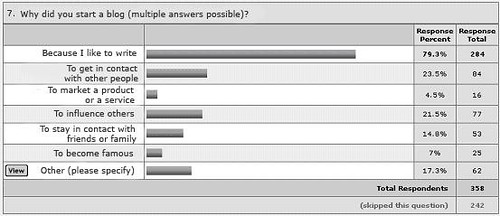
· blogs because he likes to write
· blogs in Swedish
· is not anonymous
· reads 6-10 blogs daily
· spends 6-10 hours per week reading blogs
· often or sometimes uses an RSS reader to read blogs
· reads blogs because it is more personal than other media
· finds new blogs via links on other blogs
Blog readers: The average Swedish blog reader (including those who have their own blogs) is:
· man
· 26-30 years old
· has a college/university degree
· both parents are born in Sweden
· would vote for Moderaterna – the moderate party – if there was an election today
· has his own blog
· reads 1-5 blogs daily
· spends 2 hours per week reading blogs
· never uses an RSS reader to read blogs
· reads blogs to get different views on news
· finds new blogs via links on other blogs
Other interesting results from the survey:
· Blog readers vote to the right. The right-wing parties get 62.4% of all votes.
· Bloggers vote (slightly less) to the right. 52.6% of bloggers vote for the right-wing parties while 47.6% would vote to the left.
· Male bloggers vote to the right (57.4%).
· Female bloggers vote to the left. (s), (v), (mp) and (fi) get 55.4% of the votes.
· Among blog readers who don’t blog themselves, the moderate party (m) is the dominant party. More than a third (36.8%) of this group would vote for (m).
· Many bloggers do not know who to vote for, but female bloggers are more uncertain than male (29.8% of female bloggers, 18.5% of male bloggers)
· Women blog anonymously (60.6%), men reveal their identity (69.4%)
· Most women don’t use an RSS reader to read blogs, but most men do.
· Female bloggers have slightly higher education than male bloggers.
· Male bloggers more often blog to influence others and to become famous, than female bloggers do.
· Those who use an RSS reader, read more blogs than those who don’t use an RSS reader.
· 96.9% of respondents who read 26 blogs or more daily, use an RSS reader (often or sometimes).
· Bloggers read more blogs and spend more time reading blogs than blog readers who don’t have a blog of their own.
· Half of all blog readers spend 4 hours or more per week reading blogs, which is 34 minutes or more per day. Compared to the average Swede who spends 28 minutes per day reading a daily newspaper.
The entire report can be downloaded here (pdf 429kb) in English or here (pdf 311kb) in Swedish.
In addition, here are a few of the graphs from the report in jpg-format. The first is a graph showing reasons why bloggers started blogging.
The second shows the reasons why blog readers choose to read blogs.
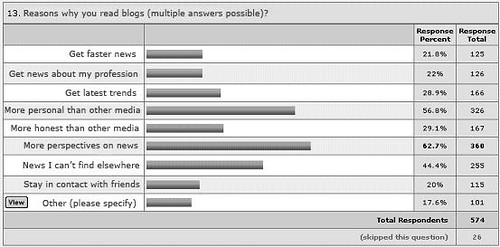
It is also interesting to compare the last graph with the corresponding question in Blogads US survey earlier this year. The results are not extremely different.